



Vitrification of nuclear waste
Research area
As part of an international collaboration, we are working in our laboratory to develop a model for the melting of the glass batch/feed in the melter. Using our mathematical model, we will be able to predict the glass production rate and help to optimize the entire melting process.
Nuclear Waste vitrification
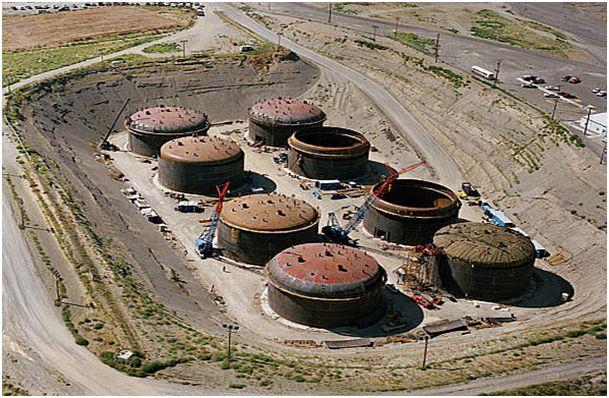
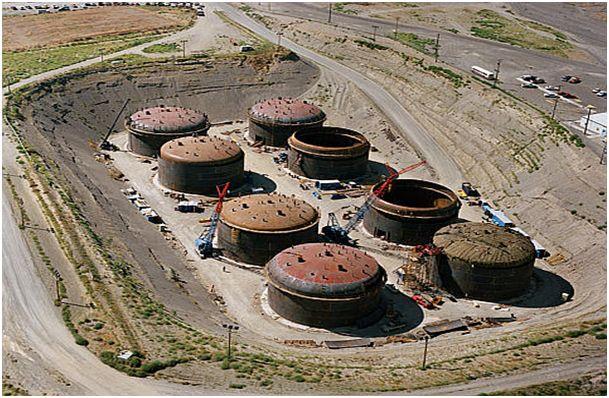
In Hanford, in the northwest of the US in Washington, more than 200,000 m3 of radioactive waste is stored in underground tanks, a result of the plutonium production during the II. World war and Cold war. This waste is stored in 177 aging underground tanks, which have problems with leakage that leads to the contamination of underground and threatens the nearby Columbia River, the second largest river on the Pacific coast of North America.
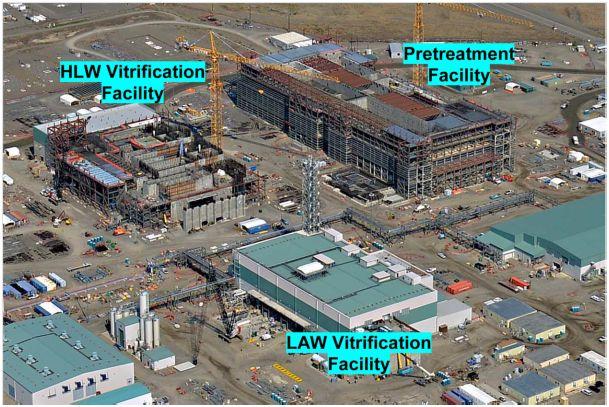
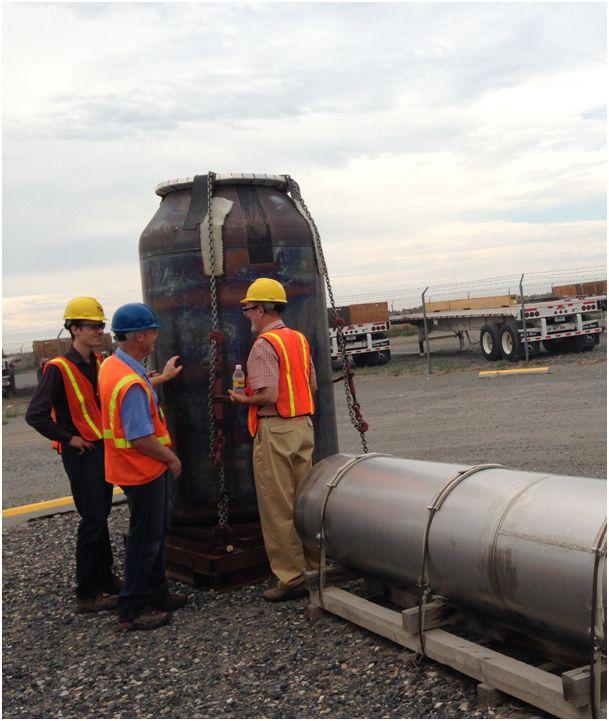
In order to process and stabilize the radioactive waste, a Waste Treatment Plant (WTP) is now being built at Hanford. The radioactive waste will be mixed with glass-forming and glass-modifying chemicals and melted at 1150 °C in an electric furnace. The resulting glass will be poured into stainless-steel canisters, where the glass will cool and solidify. In the form of glass, the radioactive waste will be stable and safe for a long-term storage in an underground repository.
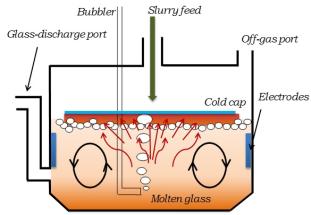
Scheme of an electrically heated melter for the vitrification of radioactive waste. Bubbling in the melt ensures better mixing of the melt and faster melting.
Although the vitrification of radioactive waste is a proven technology that has been successfully employed for decades, it has never been used on such a large scale and for such complex nuclear waste, as is stored at Hanford. The vitrification plant is thus a huge engineering challenge and one of the world's most complex remediation projects. For example, only the waste pre-treatment and separation plant (dividing the waste into low-activity and high-level fractions) has a ground plan of 165 x 65 meters, and is 12 floors high.
Our group has a long-history working on various aspects of waste glass melting at Hanford. In 2018, another two-year grant from Department of Energy (DoE USA) was awarded to our laboratory to work on the nuclear waste vitrification project at Hanford.
Selected publications
- Ferkl P., Marcial J., Rigby C., George J., Anand K., Pezl R., Kloužek J., Scrimshire A., Prokhorenko O., Hrma P., Kruger A., Pokorný R. (2026): Heat Transfer in Nuclear Waste Glasses: Measurements and Modeling of Thermal Radiation Properties. Journal of the American Ceramic Society 109, e70647. doi:10.1111/jace.70647
- Hrma, P., Ferkl, P., Pokorný, R., & Kruger, A. A. (2026). Unifying Arrhenius and non-Arrhenius viscosity with sigmoid crossovers in glass-forming liquids. Journal of Non-Crystalline Solids 681, 124049. doi: 10.1016/j.jnoncrysol.2026.124049
- Eret M., Löwy L., Kloužek J., Cincibusová P., Vernerová M., Perná I., Kohoutková M., Bezdicka P., Hrma P., Kruger A., Pokorný R. (2026): Effect of Silica Particle Size and Primary Foaming Intensity on Rhenium Retention during High-Level Waste Glass Melting. Journal of the American Ceramic Society 109, e70612. doi: 10.1111/jace.70612
- Pezl R., Kloužek J., Vernerova M., Cincibusova P., Msallamova S., Jin T., Ferkl P., Hrma P., GuillenD., Kruger A., Pokorny R. (2025): Dynamic and static corrosion of chromium-alumina refractory in simulated nuclear waste glass. Ceramics International 51, 60583-60591. doi: 10.1016/j.ceramint.2025.10.255