






Modeling of glass melting process, new concepts
Mathematical simulations of melting process
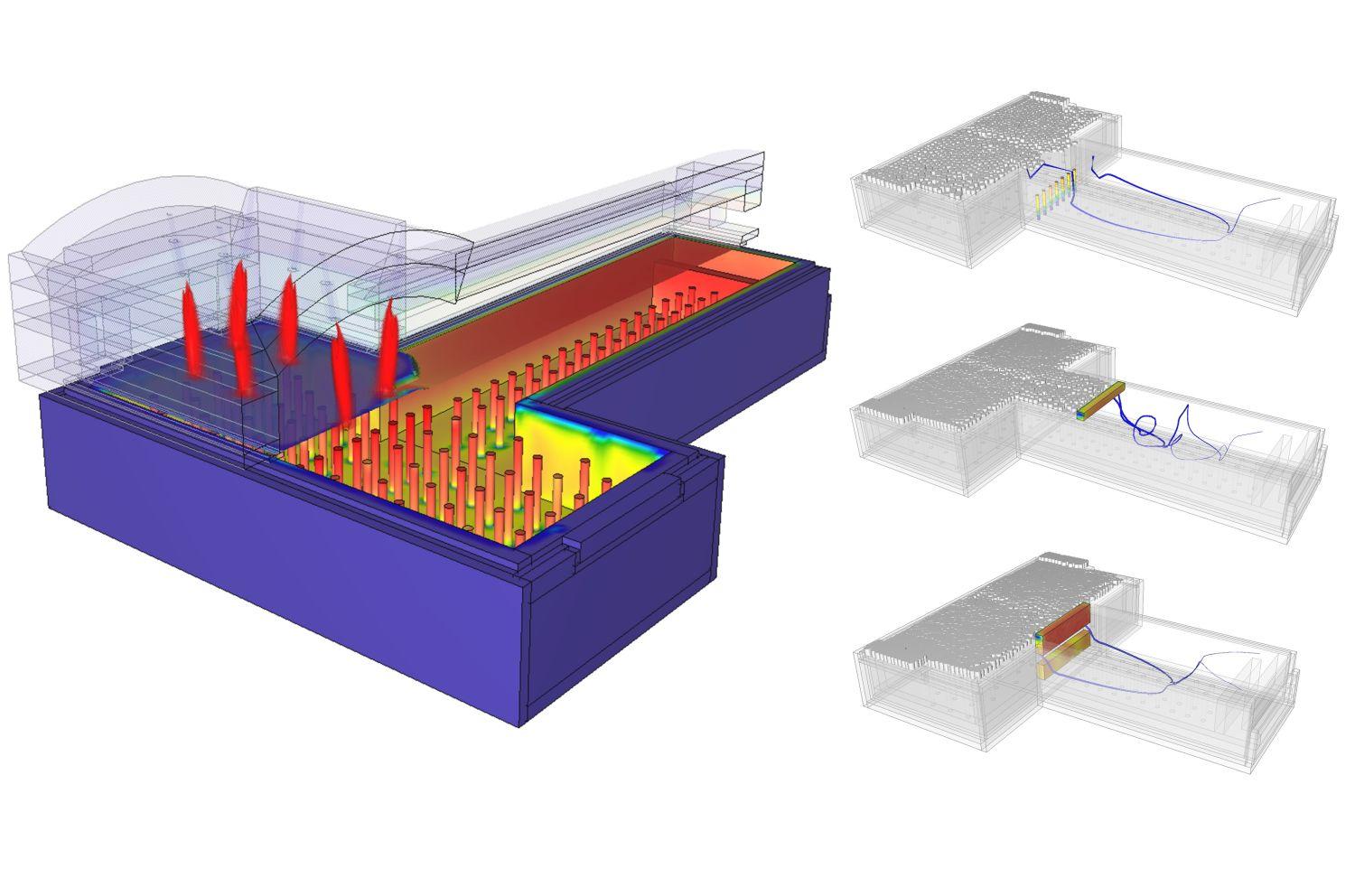
Mathematical modeling is now a traditional procedure for investigating the melting process of glasses. Computed Fluid Dynamics (CFD) methods based on the simulation of mass, momentum and energy transfer are used to calculate the velocity and temperature fields of the melt in the melting device.
Utilization of melting space
A new relative quantity has been introduced – the melting space utilization u, which quantitatively evaluates the main melting processes in the continuous space. The value of the space utilization u obtained by mathematical modeling includes dead and unused spaces for the process, and ranges from 0–1. Current glass melters have a value of around 0.05 due to the disadvantageous type of flow. Modeling of various types of flow in the model space has shown that utilization values of up to 0.8 can be achieved by establishing a certain type of spiral flow (proportional increase in performance and reduction of heat losses). The found favorable modeling results are transferred to real melting spaces and are used to design new melters.
Behaviour of bubbles in centrifugal field
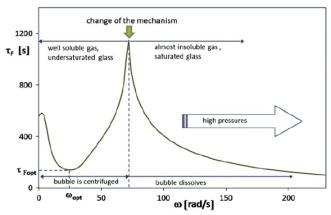
Angular speed of rotation and its effect on the time of bubble removal from molten glass. The optimal angular speed is around 25 rad/s, when the bubble residence time is the shortest.
The competition of two phenomena takes place in the centrifugal field: bubble dissolution and centrifugation. Skimming is a faster process on favorable terms. Mathematical and experimental modeling can find optimal process conditions. Optimum conditions can be applied to melt glass or other viscous liquids, provided similar behavior of bubbles.
Behaviour of bubbles under reduced pressure
Experimental modeling in laboratory conditions showed that the reduction of the external pressure in the range of 20 – 40 kPa at temperatures around 1300°C brings roughly the same intensity of the bubble removal process as in conventional melting furnaces working under normal pressure and at maximal temperatures in the melt above 1500°C. Moreover, it is often possible to significantly reduce the concentration of environmentally problematic refining agents. The figure on the left presents the results of a parametric study showing the dependence of the space pull rate on temperature and pressure.
Selected papers
- Jebavá M., Cincibusová P., Tonarová V., Němec L. (2024): Influence of energy distribution, melting temperature, kinetics and space geometry on glass melting efficiency. Journal of Non-Crystalline Solids 646, 123227. doi:10.1016/j.jnoncrysol.2024.123227
- Cincibusová P., Jebavá M., Tonarová V., Němec L. (2022): Impact of melt flow on the process of glass melting. Journal of Asian Ceramic Societies 10 (3), 621-637. doi:10.1080/21870764.2022.2099102
- Jebavá M., Hrbek L., Cincibusová P., Němec L. (2021): Energy distribution and melting efficiency in glass melting channel: Effect of configuration of heating barriers and vertical energy distribution. Journal of Non-Crystalline Solids. 562, 120776. doi:10.1016/j.jnoncrysol.2021.120776
- Němec L. (2015): Modelling of the controlled melt flow in a glass melting space — Its melting performance and heat losses. Journal of Non-Crystalline Solids 430, 52-63. doi:10.1016/j.jnoncrysol.2015.08.039
- Němec L., Jebavá M., Dyrčíková P. (2013). Glass melting phenomena, their ordering, and melting space utilisation. Ceramics-Silikáty, 57(4), 275-284. Open Access
- Cincibusová P., Němec L. (2012). Sand dissolution and bubble removal in a model glass-melting channel with a melt circulation. Glass Technol.: Eur. J. Glass Sci. Technol. A, 53(4), 150-157. Ingentaconnect
- Polák M., Němec L. (2012). Mathematical modelling of sand dissolution in a glass melting channel with controlled glass flow. Journal of Non-Crystalline Solids, 358(9), 1210-1216. doi:10.1016/j.jnoncrysol.2012.02.021
- Tonarová V., Němec L., Kloužek J. (2011). The optimal parameters of bubble centrifuging in glass melts. Journal of Non-Crystalline Solids, 357, 3785-3790. doi:10.1016/j.jnoncrysol.2011.07.028
Patents
- Němec, L., Jebavá M., Cincibusová P., Budík P., Tonarová V. (2022): Glasschmelzofen. Užitný vzor DE 20 2021 106 406 U1.
- Němec, L., Jebavá M., Cincibusová P., Budík P., Tonarová V. (2021): Způsob tavení skla ve sklářské tavicí peci a sklářská tavicí pec k provádění způsobu tavení. Patent CZ 309094.
- Němec, L., Jebavá M., Cincibusová P., Budík P. (2021): Sklářská tavicí pec s konverzním regionem pro přeměnu sklářské vsázky na skelnou taveninu a způsob konverze. Patent CZ 308684.
- Němec L., Hrbek L., Jebavá M., Brada J. (2018): Tavicí prostor kontinuální sklářské tavicí pece. Patent CZ 307659.
- Němec, L., Kloužek, J., Tonarová, V., Jebavá, M. (2014): Zařízení k čeření skloviny odstřeďováním. Patent CZ 304299. UPV
- Polák, M., Němec, L., Cincibusová, P., Jebavá, M., Brada, J., Trochta, M., Kloužek, J. (2014): Sklářská tavicí pec pro kontinuální tavení skel řízenou konvekcí skloviny. Patent CZ 304703. UPV
- Němec, L., Kloužek, J., Tonarová, V., Jebavá, M. (2013): Způsob čeření skloviny odstřeďováním. Patent CZ 304044. UPV