






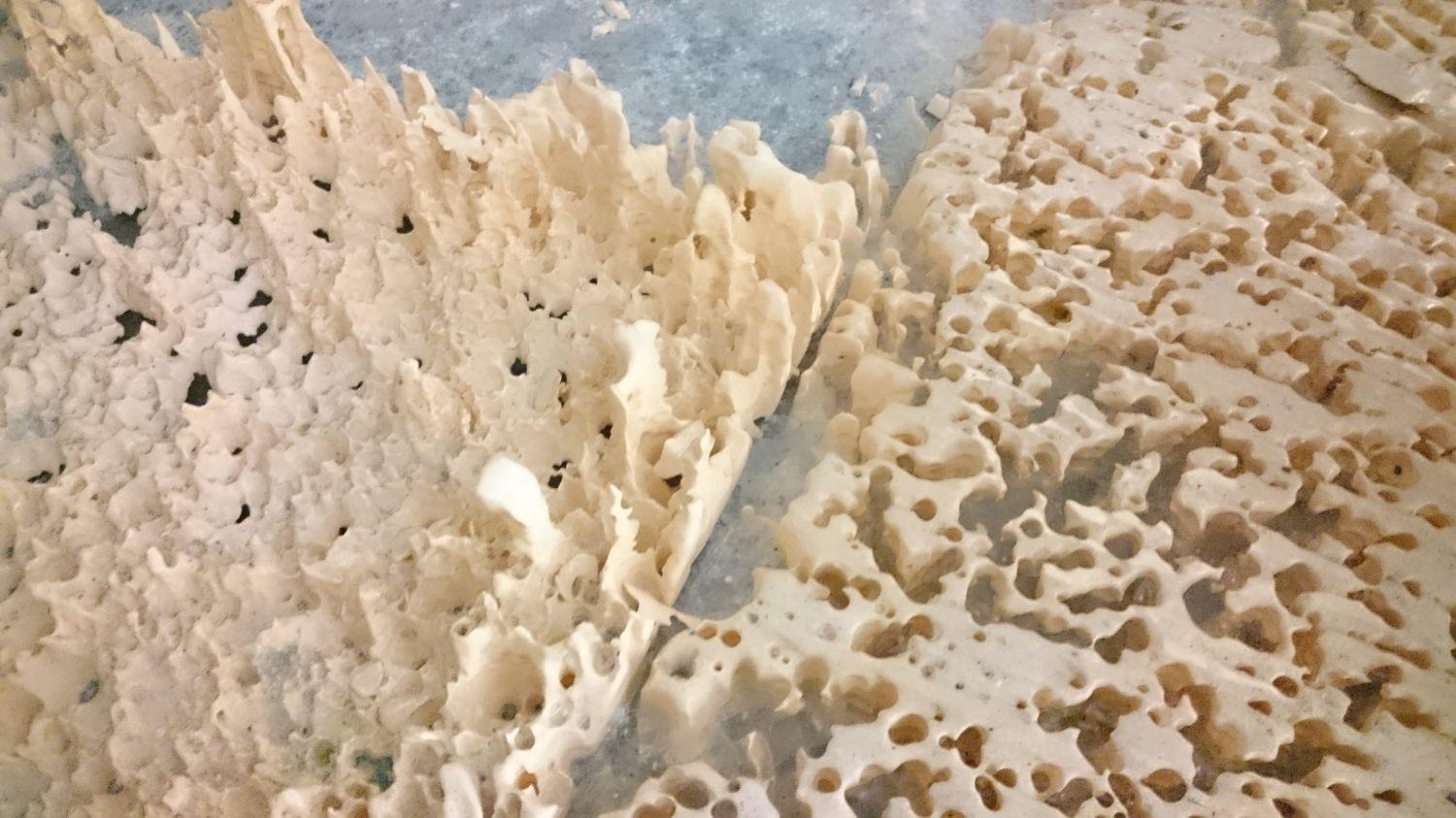
Glass melting processes
Bubble behaviour in glass melts
Gaseous or solid inclusions are the most common cause unacceptable product defects and may adversely affect the operation of the device. For a description of their behavior in the melt, we use a combination of experimental and mathematical techniques. The experiments reveal the mechanism of controlling phenomena, provide the input data and verify the mathematical model. Mathematical description, which is based on a set of differential equations describing the rate of change of the bubble size and composition is usually applied to the pre-computed velocity and temperature fields.
Nucleation of bubbles
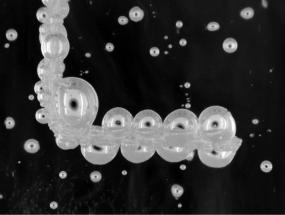
Bubble nucleation on a Pt wire immersed in molten glass.
Methods of high-temperature observation and image analysis were used to determine the temperature at which bubbles nucleate at a platinum wire immersed in the glass melt.
Bubbles growing during slow linear increase in temperature were identified and their diameter measured. The dependence between the diameter of bubbles and the temperature was extrapolated to zero size of the respective bubbles, and thus determines the temperature of nucleation.
Chemical reactions evolving gases
In particular, reactions of sulfur compounds with reducing or oxidizing agents affect nucleation and separation bubbles, foaming of the melt and dissolution of the refractory particles.
Influencing the reactions kinetics can optimize the melting process.
Corrosion of refractories by melts
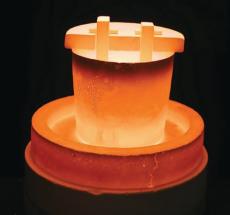
Static corrosion test of refractory material. The refractory material is immersed in corroding glass in Pt crucible.
Isothermal static or dynamic corrosion tests follow the mechanism and kinetics of corrosion processes, evaluates changes in the microstructure of the refractories and predict the amount resulting from defects in the glass - blisters and crystalline inclusions.
Electrochemical processes at the interface of electrode and molten glass
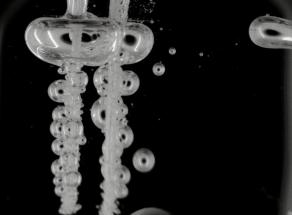
Development of oxygen bubbles on heating molybdenum electrodes in borosilicate glass melt under passage of electrode current.
The causes and mechanisms of corrosion, development of bubbles and the release of condensed reaction products at the interface of materials, in particular molybdenum, platinum and tin-oxide based material are studied. The following experimental techniques are used: the electrical potential monitoring, the evaluation of the direct electrode mass losses, the study of the interface electrode-melt by SEM analysis .
Identification of bubble sources in industrial melting space
For the expected sources the laboratory measurements of the bubble size distribution, composition and release frequency of bubbles into the melt is performed. The results create a knowledge data base. Experimental values forms also the boundary conditions of the mathematical model of the bubble behavior in the melting furnace. The comparison of product defects analyses and the values obtained from the database and the results of the model makes possible to locate the source of the defects.
Selected papers
- Kloužek J., Cincibusová P., Vernerová M., Hrma P., Pokorný R. (2021): Visual observation of foaming at the batch-melt interface during melting of soda-lime-silica glass. Ceramics-Silikaty 65, 410-416. doi: 10.13168/cs.2021.0044
- Ueda N., Vernerová M., Kloužek J., Ferkl P., Hrma P., Yano T., Pokorný R. (2021): Conversion kinetics of container glass batch melting. 103, 34-44. Journal of the American Ceramic Society. doi: 10.1111/jace.17406
- Vernerová M., Němec L., Kloužek J., Hujová M. (2018): Gas Release Phenomena in Soda-lime-silica Glass. Journal of Non-Crystalline Solids 500, 158-166. doi: 10.1016/j.jnoncrysol.2018.07.058
- Vernerová M., Kloužek J., Němec L. (2015). Reaction of soda-lime-silica glass melt with water vapour at melting temperatures. Journal of Non-Crystalline Solids, 416, 21-30. doi:10.1016/j.jnoncrysol.2015.02.020
- Vernerová M., Cincibusová P., Kloužek J., Maehara T., Němec L. (2015). Method of examination of bubble nucleation in glass melts. Journal of Non-Crystalline Solids, 411, 59-67. doi:10.1016/j.jnoncrysol.2014.12.025
- Matěj J., Jebavá M. (2014). Oxygen bubble development on a platinum electrode in borosilicate glass melt by the effect of alternating current. Ceramics-Silikáty, 58, 249-259. Open Access
- Němec L., Vernerová M., Cincibusová P., Jebavá M., Kloužek J. (2012). The semiempirical model of the multicomponent bubble behaviour in glass melts. Ceramics-Silikáty, 56, 367-373. Open Access
- Matěj J., Langrová A. (2012). Reaction products and corrosion of molybdenum electrode in glass melt containing antimony oxides and sodium sulphate. Ceramics-Silikáty, 56, 280-285. Open Access