






Special glasses for photonics and optoelectronics
With the development of technology comes constant new and new requirements for new materials. The same is true in the field of optics, optoelectronics (an interdisciplinary field dealing with the transmission and processing of optical signals) and other related fields.
Special glasses can be divided into the following basic groups:
Halide glasses. Often toxic, volatile during preparation, sensitive to moisture; transmit radiation in the UV/VIS-MIR range.
Chalcogenide glasses. Preparation must be carried out in an inert atmosphere or in a vacuum (otherwise they react with atmospheric oxygen), often contain toxic components (As); transmit radiation in the VIS/NIR-MIR range.
Heavy metal oxide glasses. Problems with product purity, a major disadvantage is especially the presence of OH- groups causing strong absorption at a wavelength of 2.9 mm; transmit radiation in the VIS-NIR/MIR range.
Mixed glasses. For example, oxychloride glasses, chalcohalide glasses, …
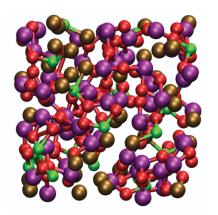
3D structure of glass of the ZnBr2-Sb2O3 type (Sb - purple, Zn - green, O - red, Br - brown).
Applications of special glasses:
- Applications of passive optical materials, which include, for example, the transmission of optical signals (communication, remote spectroscopy, ...), the transmission of energy from high-power lasers (applications in surgery, engineering, ...), image transmission using fiber bundles, various fiber sensors, and of course, lenses and instrument windows
- Applications of active optical materials (doped with rare earth ions) - fiber laser radiation sources, optical signal amplifiers, various sensors, etc.
- Applications of nonlinear optical materials - the nonlinearity of the response of matter during its interaction with intense radiation is used, for example, the generation of a secondary harmonic frequency, multi-photon absorption, self-focusing of radiation, etc.
Selected publications
- Kostka P, Yatskiv R., Grym J., Zavadil J. (2026): Enhancing near-infrared emission in Nd3+/Er3+ tellurite glasses through Cr3+ co-doping. Ceramics International 52 (9), 11953-11958. doi: 10.1016/j.ceramint.2026.01.352
- Smolík J., Knotek P., Kostka P., Kutálek P., Černošková E., Melánová K., Schwarz J., Todorov R. , Černošek Z., Čapek J., Yatskiv R., Tichý L. (2026): CW laser-induced microlens and PbS nanoparticle formations in Sb2O3-based glasses. Ceramics International 52 (26), 49525-49537. doi: 10.1016/j.ceramint.2026.08.214
- Kostka P., Jílková K., Bošák O., Kubliha M., Michalcová A., Kudrnová M., Bártová K., Dománkováa M., Kolárová M., Míka M. (2024): Electrical properties of PbO-Bi2O3-Ga2O3 glasses with addition of Ag2O and Sb2O3. Ceramics International 50, 10098-10107. doi: 10.1016/j.ceramint.2023.12.319
- Verger L , Coudray S., Bertrand E., Lebullenger R., Rocherullé J., Bosak O., Kubliha M., Labas V., Kostka P. (2024): Preparation and characterization of glasses in the TeO2-Ga2O3-M2O (M=Li, Na, K) systems. International Journal of Applied Glass Science 15, 203-211. doi: 10.1111/ijag.16661