






Polarized light microscopy
Despite its more than 170-year tradition, polarization microscopy still maintains a valid place in the field of materials studies. The method uses the interaction of polarized light with optically anisotropic substances, which causes so-called birefringence. After passing through the sample, the original beam is divided into two new ones, ordinary and extraordinary, which are phase-shifted from each other (they propagate at different speeds) and oscillate in different planes. In the microscope analyzer, both beams are folded into the same plane of oscillation and their phase shift is reflected in the formation of interference colors.
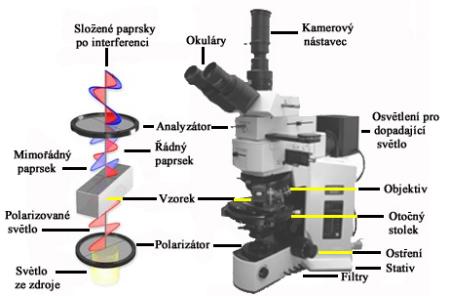
Polarizing microscope Olympus BX 51P
Polarizing microscopy can therefore be characterized as a method of increasing the contrast of the microscopic image. However, it is still used today as an additional method of identifying crystalline substances, e.g. by measuring the height of the birefringence using a Berek compensator.
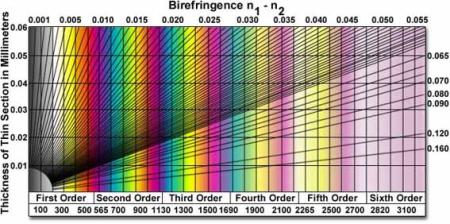
Michel-Lévy scale of interference colors for determining the height of the birefringence.