






Oxygen partial pressure in melts
When assessing the conditions for the formation of defects in the glass melt, the oxidation-reduction state of the melt also plays an important role. The redox state expresses the relationship between higher and lower oxidation forms of transition metal ions present in the melt, and this ratio depends on the partial pressure of oxygen dissolved in the melt. These are mainly ions of iron, chromium, coloring oxides and further fining additives.
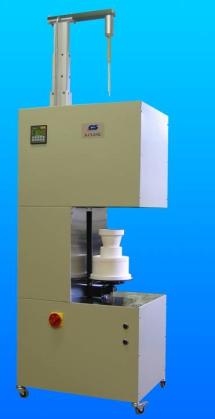
Rapidox measuring apparatus
Measuring the redox state allows for control of the resulting color of the melt, its heating and cooling (effective thermal conductivity value) and the course of bubble removal (fining process). The redox value of the glass melt is also important data when calculating the distribution of oxidation-reduction components in glass melting areas, when calculating the behavior of bubbles, which are important for optimizing the fining process and for identifying the sources of bubbles.
A commercially available method for measuring the redox state of the melt is the Rapidox system. The principle of determination is electrochemical measurement of the equilibrium voltage between the reference and measuring electrodes. The measuring electrode consists of a Pt or Ir wire. The reference electrode is placed in a Ni/NiO mixture guaranteeing a defined partial oxygen pressure. The conductive connection between the measured melt and the reference mixture is formed by a partition made of cubic zirconium oxide. From the measured electromotive force E (V), the partial oxygen pressure is calculated using the Nernst equation:

where F - Faraday constant (96,485 C mol-1), R - gas constant (8.314 J mol-1K-1), T - absolute temperature.
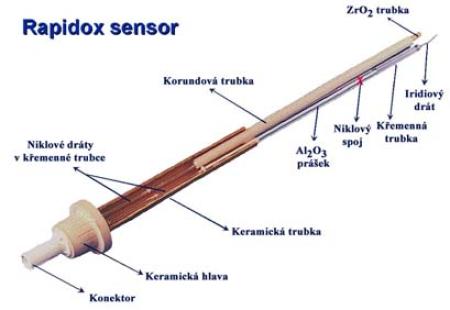
Measuring probe
The table lists the values of the oxygen partial pressure in selected industrial types of glass at a temperature of 1200 °C.