






Solubilities of gases in melts
The determination of gas solubility in melts consists of two steps. In the first step, the melt is saturated with pure gas. After reaching equilibrium, the melt is rapidly cooled to room temperature. The concentration of dissolved gas is then determined by the gas chromatography method described below.
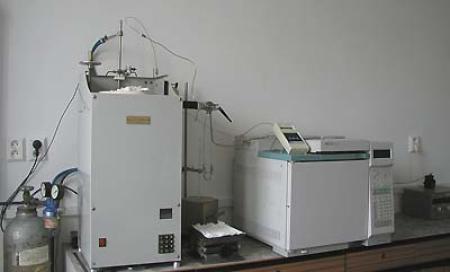
The principle of the method for determining gases dissolved in glass melts is the continuous extraction of a sample by stream of inert gas and the subsequent chromatographic analysis of the released gases.
Measuring apparatus for the analysis of gases in melts.
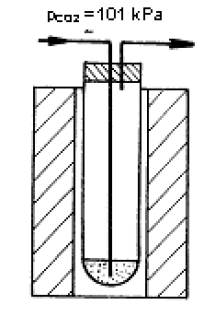
The analyzed glass sample in the form of a beam with dimensions of 5 x 5 x 10 mm is placed in a silica glass tube inserted in a laboratory furnace heated to a temperature of 1500 °C. At the bottom of the tube, a silica glass capillary opens, through which helium flows.
The released gases are captured in a concentration loop immersed in liquid nitrogen. After the extraction is completed (60 minutes), the loop is rapidly heated by immersion in hot oil and connected to the carrier gas circuit of the chromatograph.
Scheme of gas saturation of the melt.
The determination method allows the simultaneous determination of carbon dioxide, oxygen, nitrogen and sulfur dioxide. Other gases dissolved in the glass, i.e. water vapor and possibly argon, cannot be determined in the above arrangement.
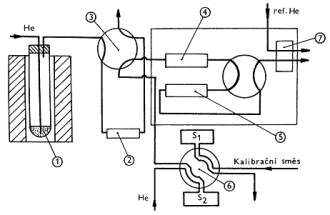
Diagram of apparatus for determination of gases in melts:
- Analyzed sample
- Concentration loop
- Six-way valve
- Column with Porapak QS
- Column with Molecular Sieve 5A
- Eight-way valve with calibration loops S1 and S2
- Thermal conductivity detector