






Visual observation of glass melting processes
26. 11. 2026
Marcela Jebavá
The method uses the transparency of most glasses in the visible region (or in the near infrared around 2 mm) even at melting temperatures.
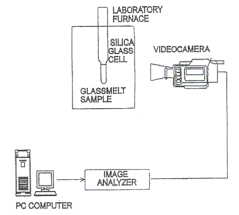
The principle of the method is to monitor a sample located in a silica cuvette and in a laboratory furnace with a viewing window. The process is monitored by a digital video camera. The image recording is evaluated by the NIS-Elements image analysis software.
Scheme of the experimental methodology.
Observation options for various processes:
- Monitoring melt with bubbles, when either the image created after melting the charge is recorded directly, or artificial bubbles are prepared in the already melted glass by blowing out. The method is used for high-temperature observation of the entire melting process, clarification processes, and foam formation on the surface of the melt. By observing the surface, information can be obtained about the behavior of the foam or the stability of the bubbles on the surface.
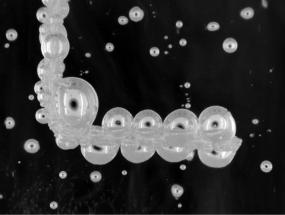
- Determination of bubble nucleation temperature. The temperature of secondary bubble formation (reboil) is determined based on direct visual observation of the formation of bubbles on a platinum wire immersed in the glass. The sample temperature is increased at a rate of 2°C/min. The observed growth of the formed bubble with temperature is evaluated by image analysis and the reboil temperature is determined by extrapolation to the zero bubble size.
Nucleation of bubbles on Pt wire immersed in molten glass.
- Monitoring the development of bubbles from refractory materials - corrosion tests of refractory materials.
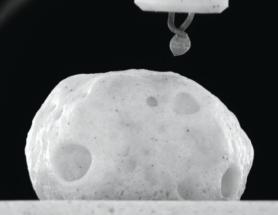
- Determination of foaming curves using pellet tests. A sample of batch (feed) is not placed in a silica cuvette, but is pressed into the shape of a small pellet with a diameter of 1 cm, and placed on refractory substrate and then inserted into a laboratory furnace. The evolution of gases during heating of the pellet is monitored and the change in volume is evaluated using image analysis.
Pellet test of batch expansion during heating.